

Why we’re building Hubly Links around the people trying to reach your business—and the questions you still have after they do.
Someone sees a haircut they love on Instagram. They tap the barber’s profile, looking for a price and an appointment. Someone else passes a restaurant, scans the code in its window, and wants to see the menu before deciding whether to walk in.
The interest is already there. What happens next matters.
For the customer, it should be easy: understand the business, find the right information, take the next step. For the owner, there is another question waiting at the end of the day: Which of the things I’m doing to bring people in are actually helping?
Hubly Links is being built around both sides of that moment.
A front door that helps people get somewhere
A business can be everywhere online and still be surprisingly difficult to use.
The menu is in one place. Booking lives somewhere else. A service price is buried in a post. The customer has found you, but now they have to piece the business together.
A Hub gives those essentials a shared home. Business information, menus, services, booking links, calls, directions, and inquiries can sit together in a page organized around what someone came to do.
For a restaurant, that might mean making the menu, ordering destination, and directions easy to find. For a service business, it might mean putting services and an appointment link within reach. The experience should reflect the business rather than make every visitor work through the same collection of unrelated links.
Your existing booking or ordering provider can remain part of that journey. Hubly gives people a clearer way to reach it.
That is the first reason to use Hubly: a person who is ready to become your customer deserves a clear next step.
The question behind the numbers
Owners need clarity too.
A busy page can feel encouraging. So can a campaign that generates plenty of taps. But opening a booking link and completing a booking are different events. Asking for directions does not establish that someone walked through the door.
Hubly keeps three things separate: the visit, the action, and the confirmed result.
A visit tells you someone arrived. An action tells you what they chose to do. A confirmed result requires evidence from a connected, supported system that the relevant outcome occurred.
When that connection is available and configured, Hubly can bring reported outcomes into the picture. It also keeps the strength of the connection visible: an exact match, an inferred relationship, or an outcome whose source remains unknown.
A confirmed purchase and a confirmed explanation of where that purchase came from are two different things.
That distinction is central to the product. A result can be real even when its marketing source is unclear. Showing that gap gives an owner a more useful basis for a decision than quietly filling it with confidence.
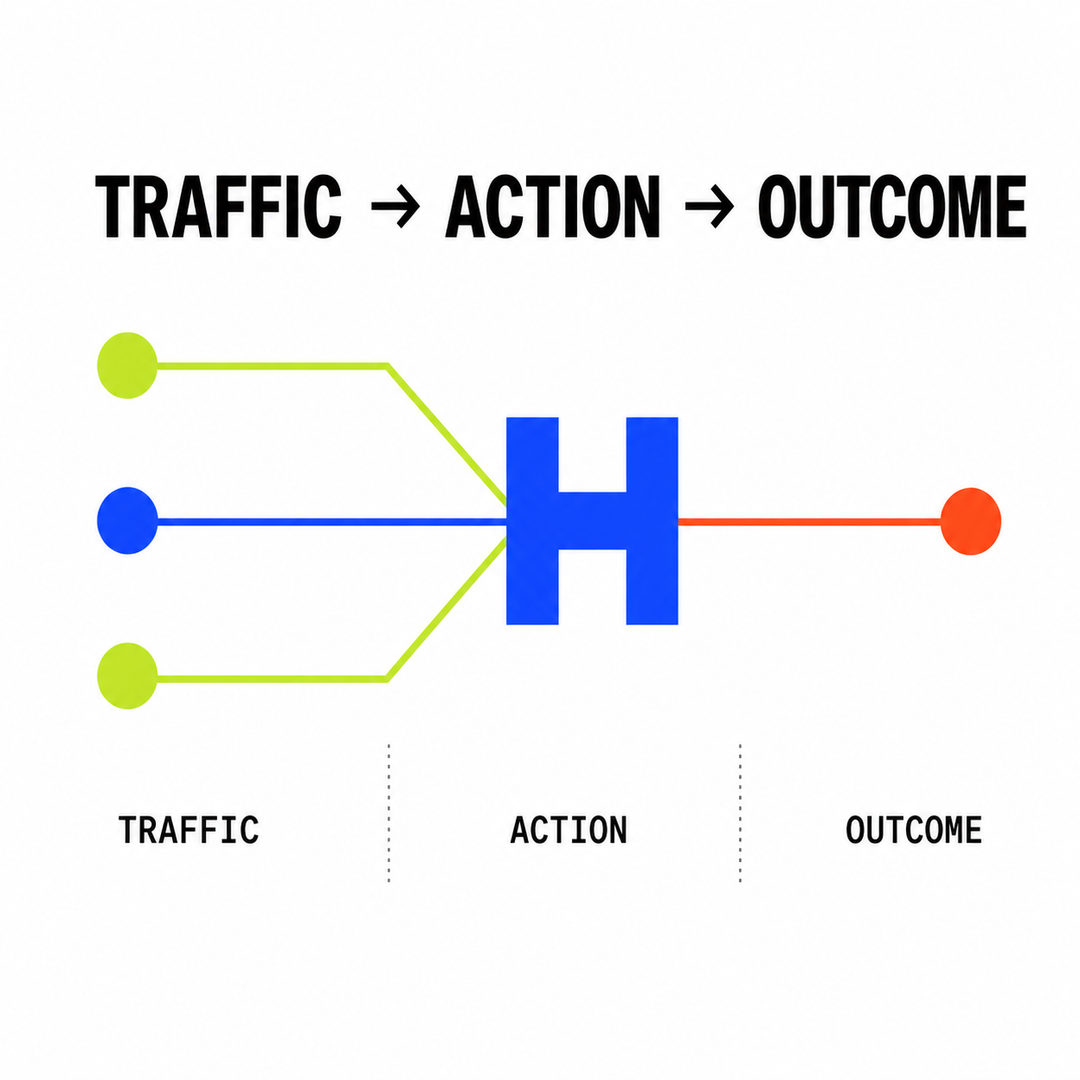
Every step answers a different question: where someone arrived from, what they chose to do, and what the available evidence confirms.
Where Hubly takes its own direction
Link-in-bio tools have become capable products. Linktree offers analytics, customization, and marketing features. Beacons brings together a link-in-bio page, a creator store, email marketing, and brand-deal tools. Those are meaningful options for the audiences they serve. (Linktree features, Beacons product overview)
Hubly’s case comes from the way it brings customer actions and business evidence together.
Its organizing question is practical: What brought someone here, what did they do next, and how much of the result can we actually account for?
That question connects the customer-facing Hub with campaign links, QR codes, reporting, and workspaces for clients or locations. A promotion has a destination. That destination gives people relevant actions. The owner can then examine the available trail between the source, the action, and the outcome.
For a local operator or an agency, that combination is the reason to look closely at Hubly. The value lies in having those parts work together around the same business question. It does not depend on claiming that every individual feature is exclusive.
What that means for our clients
Consider a restaurant promoting a weekend menu through social posts and a printed flyer. Campaign-specific links and QR codes give those routes their own identity. Customers reach a useful destination, while the owner can compare the actions associated with each campaign. Completed orders only enter the confirmed-results story when a supported result source supplies that evidence.
For a barber or another appointment-based business, the benefit begins before reporting: people can find services and reach the booking destination with less searching. The owner can distinguish interest in booking from a booking that a connected system confirms.
For an agency, the same approach changes the client conversation. Each business or location can have its own Hub, with campaigns and evidence organized in the workspace. The discussion can move through concrete questions: Which source brought visitors? Which action drew interest? What result was reported? Where is the connection still uncertain?
These are examples of how Hubly can be used, rather than claims about measured client results. The practical impact we are designing for is clear: easier customer journeys and better-informed conversations about what to do next.
For agencies and businesses with several locations, keeping the context together is part of making the evidence useful.
Why we think this deserves to be built
Small businesses put real work into getting noticed. They take photographs, answer messages, update menus, print materials, and pay for campaigns—often while running the business itself.
That effort deserves a useful destination. It also deserves reporting that respects the difference between interest and a result.
This is what makes Hubly worth developing. The problem sits in an ordinary, repeated part of business life: a customer trying to act and an owner trying to understand. Improving that moment can make the product useful long before anyone opens a detailed report.
Our development standard follows from it. Can a customer find the next step? Can the owner understand the evidence? Can an agency explain it to a client without making a stronger claim than the data supports?
Those are questions worth continuing to build around.
Start with the next step your customer needs
If your business sends people across several platforms, or your reporting leaves you wondering what happened after a click, Hubly is worth exploring.
Start with one customer action that matters to you. Make it easy to find. Then follow the evidence as far as it goes.
Explore the Hubly product demo or apply for founding access.
 01
 02