

A product journal about Taldi, the retail shift companion we’re building for the people who keep stores moving.
You’re halfway through checking a display when someone asks about a delivery. On the way to receiving, a colleague catches you with a question. A customer needs help finding something. By the time you get back to the aisle, you’ve handled three things—and you’re trying to remember the one you started.
That is a perfectly ordinary retail shift.
It is also the moment we keep coming back to as we develop Taldi, the project previously known as NXT. Because a useful tool for retail has to make sense here: on your phone, between conversations, with the day already moving around you.
Taldi’s promise is simple: keep tasks, routines, and follow-ups together during a changing shift.
The ambition behind it is personal. We want the work you meant to return to to have somewhere to wait.
Built around the moment you get interrupted
Retail managers carry a surprising amount of work in their heads. There are the visible jobs: the floor walk, the display, the closing routine. Then there are the small commitments threaded through them. Check back with someone. Look into that missing ticket. Find out whether yesterday’s issue was resolved.
Each commitment is easy to understand. Remembering all of them while the shift keeps changing is the difficult part.
That is why Taldi starts with the rhythm of the floor. Capture a specific action. Give it useful context. Return to it when you can act. Review what still needs attention.
In our native iPhone demonstration, that rhythm takes a very ordinary form: “Check the oat milk endcap.” The task is saved under Grocery, opened again later, and marked complete after the check. The store and people in the demonstration are fictional; the recorded app interaction is real.
There is no grand transformation in that sequence. There is a request that survives an interruption. That small piece of continuity is the foundation we care about.
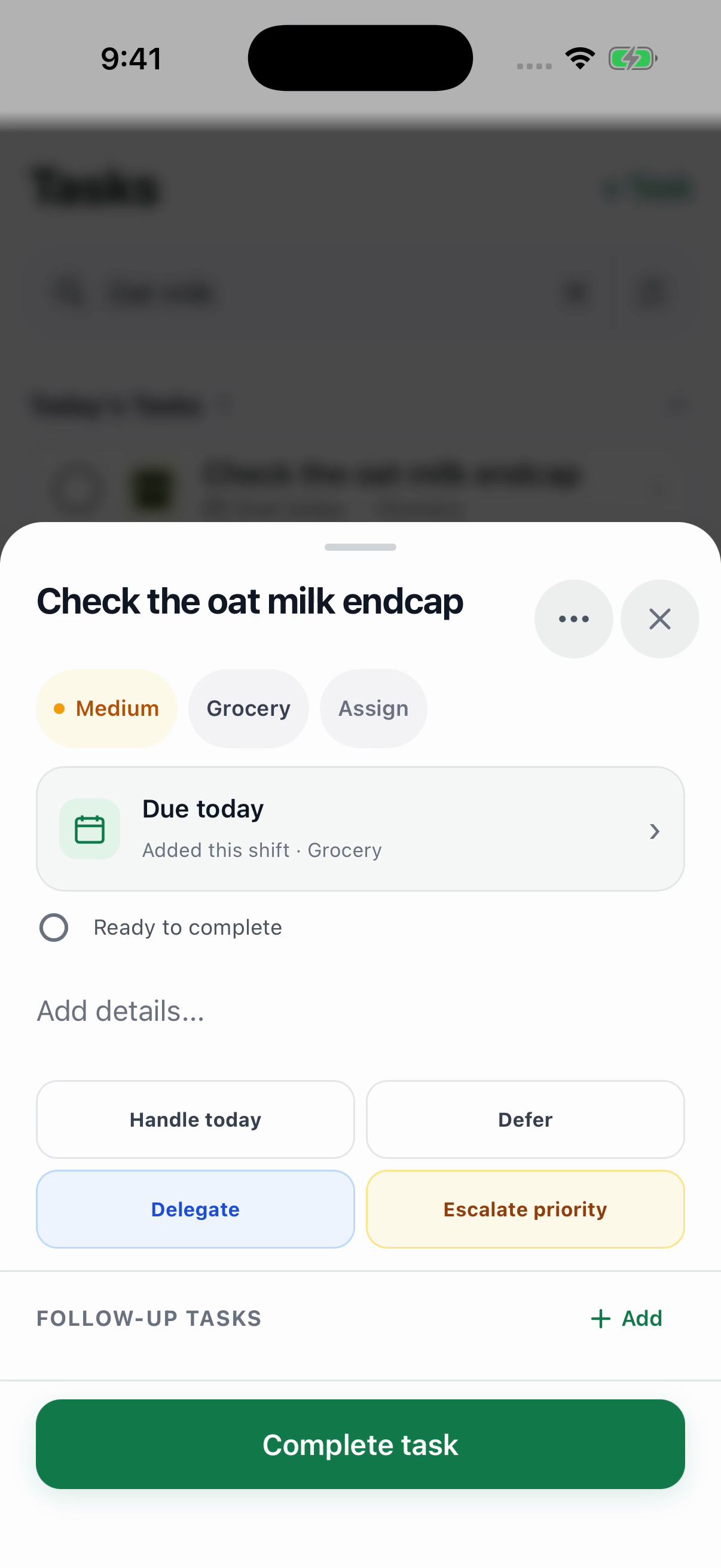
An actual iPhone simulator capture using fictional store data. The original request has a place to return to.
What makes Taldi different
There are good reasons to use the tools already out there. Todoist offers flexible task management, shared assignments, reminders, and different ways to view your work. SafetyCulture offers retail task management within a broader operations platform. Both address real needs. Todoist’s task-management overview and SafetyCulture’s retail overview describe those approaches.
Taldi’s point of view begins with a particular person: the retail manager moving between departments, requests, and responsibilities throughout a shift.
Departments, routines, store walks, follow-ups, and handoffs belong to that person’s everyday vocabulary. They shape what we are building. A task becomes more useful when you can see where it belongs, what needs to happen, and what you need to check next.
The distinction is the way those familiar jobs come together around a changing retail day. We want the path from “someone just asked me” to “I know where to pick this up” to feel natural.
For someone who already has a task system that works well, Taldi has to earn its place. For someone constantly translating floor work into scattered notes, messages, and mental reminders, that retail focus is the reason to pay attention.
Why we keep building it
A forgotten follow-up rarely arrives with a dramatic warning. It may surface as a colleague asking again, an issue waiting through another shift, or that uneasy feeling at the door when you know there was something else.
Those moments deserve thoughtful software.
Developing Taldi is worth the effort because the problem recurs in the ordinary flow of work. Capturing a request once is useful. Being able to return to it, make a decision, and carry the right context forward is where the relationship with the product can deepen.
That gives us a clear standard for development. A new feature should help someone capture, understand, act on, or follow through on real work. It should justify the attention it asks for during a busy shift.
We are continuing to develop and test Taldi against that standard. The question that matters most is whether a manager can come back after an interruption and find something useful waiting for them.
A practical reason to make it part of your shift
The first useful habit can be small. Put one request in Taldi that you would otherwise try to remember. Make it specific enough that it still makes sense two hours later. Return to it when the immediate rush passes.
“Check the oat milk endcap” gives you a clearer starting point than “Grocery.” A saved follow-up gives a conversation somewhere to continue. Reviewing open work before leaving gives you a chance to decide what comes next.
Over time, the value we want Taldi to deliver is a more dependable relationship with your own commitments. You can help the person in front of you while keeping a record of the work you stepped away from.
That is a meaningful reason to use a shift companion: having a place to put the next action, and a reason to come back to it.
The people on the other side of the task
For the managers and store operators we build for, the potential impact reaches beyond a completed checklist.
A colleague who raises an issue wants to know it will receive attention. The next manager coming on shift needs enough context to continue. A customer asking for help needs someone who can be present with them.
Keeping the work visible can support all three. A recorded request gives the manager something concrete to revisit. A reviewed handoff can make the next conversation clearer. A task you can find again gives you one less detail to rehearse while helping someone else.
These are the outcomes we are working toward. They are also how we want to judge Taldi’s usefulness: through clearer follow-through, more useful shift transitions, and the experiences of the people doing the work.

Every handoff has another person on the receiving end. Give them something useful to continue.
Retail will always bring the unexpected. The delivery arrives. The radio goes. Someone needs you halfway through something else.
We’re building Taldi for the moment after that—when you take a breath, look at your phone, and pick up the work that still matters.
Taldi. Keep track. Keep moving.
Follow along as we build and test Taldi for real retail shifts.
 01
 02