
Imagine a guest with ten seconds
Someone hears about your restaurant, opens their phone, and wants to decide whether to visit tonight. They need the current menu, location, hours, and a way to order, reserve, or contact you. If those answers are scattered across old posts and comment threads, the guest has to do the work.
Facebook and Instagram are valuable places to show food, people, and atmosphere. They are weaker as the only source of essential information because the visitor arrives inside a feed you do not organize. A restaurant website gives those practical answers a stable home.
Put the essentials first
A useful restaurant homepage should answer four questions before it asks for attention:
- What kind of food and experience is this?
- Where is it, and is it open when I want to go?
- What is on the menu, including the information guests need to decide?
- What can I do next: call, get directions, order, book, or ask about catering?
Make the action match the operation. If direct online ordering is not in place, a clear phone or messaging route is better than an “Order” button that leads nowhere. Keep the menu current and readable on a phone; a giant PDF is often a poor substitute for a mobile menu.
Give the place its own voice
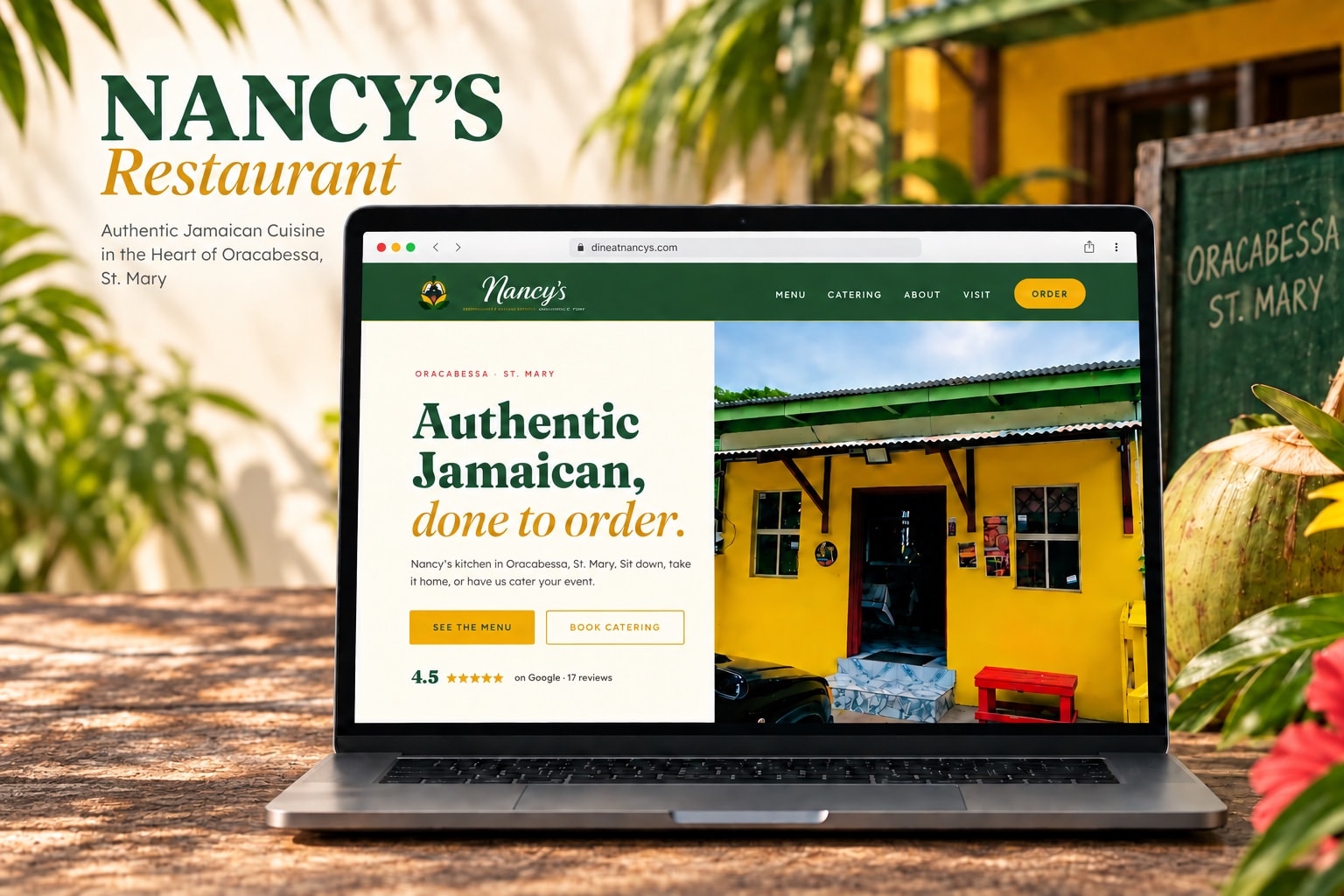
For Nancy's Restaurant in Oracabessa, the location and the hospitality belong in the experience alongside the food. A generic restaurant template would miss that. Photography of the real space, straightforward language, and directions give a prospective guest a better sense of where they are going.
The same rule applies to any local restaurant: show the actual place. Visitors can tell when a site is full of stock imagery or a menu that no longer matches what is served.
Make search and social work together
A website and a Google Business Profile should agree on the name, address, hours, phone number, and menu destination. Social posts can highlight a special or tell a story; the website can carry the permanent details. Links from every profile should take people to a useful next step.
A website does not guarantee a search ranking, and a click is not an order. Use analytics to learn which pages and actions people use, then compare that with the restaurant's own booking or ordering data where available.
Do the guest test
Open your restaurant's web presence on a phone you have not used for the business. Give yourself ten seconds to find tonight's hours, the menu, directions, and the action you would take next. Ask someone outside the team to do the same. The places they hesitate are the first places to fix.
That small test is a better brief than “we need a modern website.”
 01